

We recently brought you the first part of a very interesting article about How to Improve the Security of Industrial Communications. Today we'll continue and wrap up this post with its second and final part.
We had previously seen that the first of the ways in which it improves the security of industrial communications It involves the use of specifications associated with industry-standard secure protocols, and we mentioned OPC UA and Secure DNP3.
However, this is not enough, and two more steps will be necessary for the communications security at the industrial level ...is, at the very least, efficient.
Integration of specific cybersecurity technologies
Let's see how we can achieve this:
Protocol Whitelisting for Network Segmentation
It involves the (in-depth) inspection of function packets through the use of network electronics devices capable of segregating networks.
They must ensure that the protocol between devices or between devices and real-time systems is a specific one—with a whitelist of objects and functions associated with that protocol.
The segmentation device blocks any attempts at unauthorized code injection or communication.

Encryption and authentication of industrial protocols using IT environment standards
Certain devices that include a basic security layer can be configured and integrated into systems to evaluate communication delays and determine what latencies exist.
There are now various technologies available that incorporate these features at both the source and the destination hardware devices for setting up virtual private networks between field devices and real-time systems.
Traffic Encryption Using Algorithms
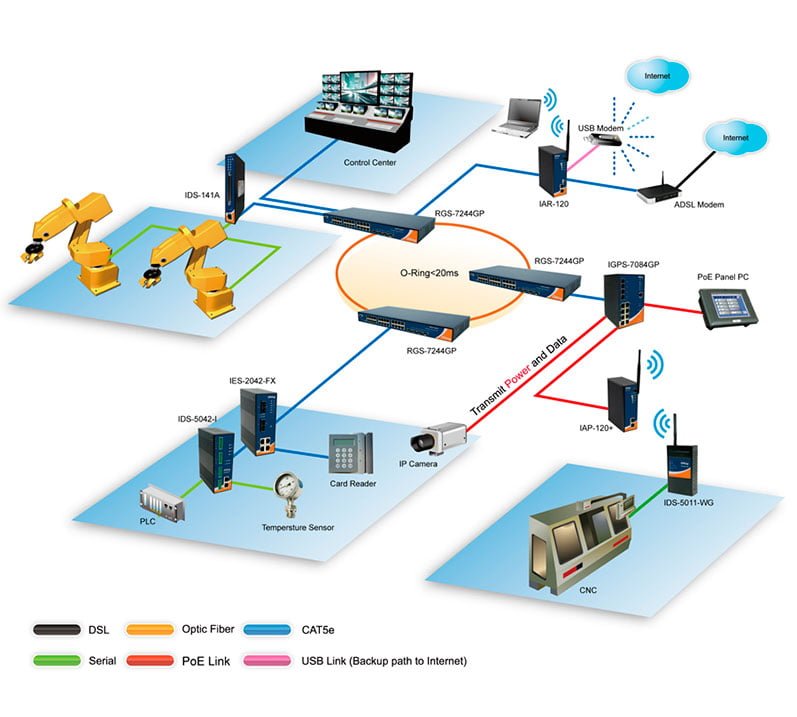
By incorporating devices capable of encrypting industrial traffic using algorithms, we are able to send encrypted data between distributed networks and the control center.
Whether it's a specific device or a network, the encryption device will enable the comunicación N a N by simply configuring the input and output channels without having to create virtual networks or redirect IP addresses, which significantly reduces the solution's total cost of ownership.
Server Hardening
Increasingly, servers dedicated to the centralization of industrial communications They are configured—that is, modified. For this reason, it is even more important that they be protected both physically and logically.
To achieve this, you can implement procedures that enable fault tolerance (using redundant, high-availability architectures) as well as incorporate more specific solutions that increase the server's availability.
And that's how we can improve the security of industrial communications.
In addition to server hardening and the implementation of specific technologies—such as whitelisting of protocols, encrypted, authenticated, and ciphered– We use specifications associated with secure protocols –such as OPC UA or Secure DNP3-, which we already saw in our Previous post on improving industrial communication security.